
Brief Updates from TheHareKrishnaMovement.wordpress.com |

- Knowledge by Way of the Mahātmās, Great Souls
- Winter
- Poem by Srila Prabhupada on His First Arrival in the USA
| Knowledge by Way of the Mahātmās, Great Souls Posted: 21 Jan 2012 08:55 AM PST No one can be equal to God, and no one can be above Him. Even Lord Brahmā and Śiva, the most exalted demigods, are subservient to Him and pay their respectful obeisances. Instead of trying to become God by some meditational process or other, we had better hear about God submissively and try to understand Him and our relationship to Him. The representative of God or the incarnation of God never claims to be God but the servant of God. This is the sign of the bona fide representative. Raja-Vidya: The King of Knowledge Knowledge by Way of the Mahātmās, Great Souls The presence of Kṛṣṇa in all aspects of the creation is perceived by the mahātmās, the great souls, who are always engaged in the worship of Kṛṣṇa. As Kṛṣṇa Himself states, these great souls are conversant with the confidential knowledge found in the Ninth Chapter of Bhagavad-gītā, and they know Kṛṣṇa to be the source of all things. mahātmānas tu māṁ pārtha "O son of Pṛthā, those who are not deluded, the great souls, are under the protection of the divine nature. They are fully engaged in devotional service because they know Me as the Supreme Personality of Godhead, original and inexhaustible." (Bg. 9.13)
The great soul knows without a doubt that Kṛṣṇa is the Supreme Personality of Godhead and that He is the origin of all emanations. The Vedānta-sūtra states, athāto brahma jijñāsā: Human life is meant for inquiring about Brahman. At present we are all engaged in studying temporary, small things. Brahman means the greatest, but instead of concerning ourselves with the greatest, we have become enmeshed in trying to solve the animal problems of eating, sleeping, defending and mating. These small problems are automatically solved. Even the animals are enjoying mating, sleeping, eating and defending. The arrangements are all provided. These demands of the body are not really problems, but we have made them into problems. The Vedānta-sūtra enjoins us not to concern ourselves with these problems, for they are satisfied in any form of life. Our problem is to inquire about the source of all these manifestations. The human form of life is not meant for struggling hard to solve the material problems which even a hog, a stool-eater, can solve. The hog is considered to be the lowest among animals, yet he has eating facility, mating facility, sleeping facility, and facilities for defense. Even if we don't strive for these things, we will have them. Man is meant, rather, to find out the source from which all these things are coming. The Vedānta-sūtra states that Brahman is that from which everything is emanating (janmādy asya yataḥ [SB 1.1.1]). Philosophers, scientists, yogīs, jñānīs and transcendentalists are all trying to find out the ultimate source of everything. This source is given in Brahma-saṁhitā, sarva-kāraṇa-kāraṇam: [Bs. 5.1] Kṛṣṇa is the cause of all causes. Understanding Kṛṣṇa to be the primal source of everything, how do the great souls act? Kṛṣṇa Himself characterizes them in this way: satataṁ kīrtayanto māṁ "Always chanting My glories, endeavoring with great determination, bowing down before Me, these great souls perpetually worship Me with devotion." (Bg. 9.14) That glorification is this process of bhakti-yoga, the chanting of Hare Kṛṣṇa. The great souls, understanding the nature of God, His descent and His mission, glorify Him in so many ways, but there are others who do not accept Him. Kṛṣṇa also mentions them in the Ninth Chapter: avajānanti māṁ mūḍhā "Fools deride Me when I descend in the human form. They do not know My transcendental nature and my supreme dominion over all that be." (Bg. 9.11) The mūḍhas, or foolish men, who are lower than the animals, deride Him. Any person who doesn't believe in God must either be a madman or fool number one. There is no reason not to believe in God, and there is every reason to believe in Him. Man may say that he doesn't believe in God, but who gives him the power to say this? When death comes, this speaking power ceases—so who is giving the power of speech? Has the speaking power come automatically from stone? As soon as the speaking power is withdrawn by the Supreme Authority, the body is no better than stone. The very power of speech is proof that there is a Supreme Power who is giving us everything. A Kṛṣṇa conscious person knows that whatever he has is not under his control. If we do not believe in God, we must believe in some power beyond us which is controlling us at every step, call that power God or nature or whatever. There is a controlling power in the universe, and no sane man can deny it. Kṛṣṇa was present on this earth and appeared just like a human being with supernatural power. At that time, however, ninety-nine percent of the people could not recognize Him as God. They could not recognize Him because they had no eyes to see (paraṁ bhāvam ajānantaḥ). How is it possible to recognize God? He can be recognized through supernatural power, by the evidence of authorities, and by scriptural evidence. As far as Kṛṣṇa is concerned, every Vedic authority has accepted Him as God. When He was present on earth, His activities displayed were superhuman. If one does not believe this, it is to be concluded that he will not believe whatever evidence is given. One must also have the eyes to see God. God cannot be seen by material senses, therefore the bhakti-yoga process is the process of purifying the senses so that we will be able to understand what and who God is. We have power of seeing, hearing, touching, tasting and so on, but if these senses are blunt, we cannot understand God. The process of Kṛṣṇa consciousness is the process of training these senses through regulated principles, specifically through the chanting of Hare Kṛṣṇa. Śrī Kṛṣṇa further characterizes the mūḍhas: moghāśā mogha-karmāṇo "Those who are thus bewildered are attracted by demonic and atheistic views. In that deluded condition, their hopes for liberation, their fruitive activities, and their culture of knowledge are all defeated." (Bg. 9.12) The word moghāśā indicates that the aspirations of the atheists will be baffled. The karmīs, or fruitive laborers, are always hoping for something better to gratify their senses. There is no limit to where they will stop. They are trying to increase their bank balance and are hoping to be happy at a certain point, but that point never comes because they do not know the ultimate point of satiation. Those who are enamored by the attractions of illusory energy cannot understand the ultimate aim of life. The word mogha-karmāṇaḥ indicates that they are laboring very hard but that in the end they will only meet with frustration. Unless we are established in Kṛṣṇa consciousness, all of our activities will be baffled at the end. This is not the verdict of an ordinary man, but of Śrī Kṛṣṇa Himself. If we are searching for knowledge, we should conduct research to find out whether Kṛṣṇa is not God. Without any objective, what is the point of thousands of years of speculation? The Supreme Lord is so vast that one cannot reach Him by mental speculation. If we travel at the speed of mind and wind for millions of years, it is not possible to reach the Supreme by speculation. There is not one single instance in which one has arrived at the Supreme Absolute Truth by means of his own mental speculation. Therefore the word mogha-jñānāḥ indicates that the process of mundane knowledge is bewildering. Through our own endeavor it is not possible to see the sun after it has set. We have to wait until the sun reveals itself in the morning at sunrise. If it is not possible with our limited senses to perceive a material thing like the sun, how is it possible to perceive the nonmaterial? We cannot find out or understand Kṛṣṇa by our own endeavor. We have to qualify ourselves through Kṛṣṇa consciousness and wait for Him to reveal Himself. teṣāṁ satata-yuktānāṁ "To those who are constantly devoted and worship Me with love, I give the understanding by which they can come to Me." (Bg. 10.10) Kṛṣṇa is within, but due to our material conditioning, we do not realize it. Those who are of the nature of fiends and demons (rākṣasīm āsurīm) think that this material life is all and that it is the purpose of human life to squeeze out as much pleasure from matter as possible. They try squeezing, but they are constantly baffled. Squeezing material nature is not the process for finding out real pleasure. If we are searching for real pleasure, we have to take to Kṛṣṇa consciousness. All happiness in the material world has a beginning and an end, but happiness in Kṛṣṇa is unlimited, and there is no end. In order to get this happiness we simply have to sacrifice a little time and chant Hare Kṛṣṇa. In former ages, the great sages and demigods used to sacrifice their whole lives for realizing the Supreme, and still they would not attain success. For this age Caitanya Mahāprabhu has given an easy process for God realization. All that is necessary is careful listening. We have to listen to Bhagavad-gītā, and we have to chant the names of Kṛṣṇa and listen to them carefully. We should not be puffed up, falsely thinking that our knowledge is great or that we are very learned. We need only become a little gentle and submissive to hear the messages from Kṛṣṇa. At present, this world is being managed by the rākṣasas. The rākṣasas are man-eaters who eat their own sons for the satisfaction of their senses. Now great regimes have been created to smash so many people for the satisfaction of the rākṣasas senses, but they do not realize that their senses will never be satisfied in this way. Nonetheless, the rākṣasas are prepared to sacrifice everything to satisfy their whimsical desires. It is very difficult for them to understand the real situation because they are overly enamored with material civilization. Who then can understand? Those who are mahātmās, whose hearts have become magnified, understand that "everything belongs to God, and I also belong to God." Such mahātmās are not under the control of material nature (mahātmānas tu māṁ pārtha daivīṁ prakṛtim āśritāḥ [Bg. 9.13]). God is great and the mahātmā's heart also becomes great by serving the great. Mahātmā is not a stamp for a political leader. One cannot be stamped mahātmā by votes. The standard for mahātmā is given in Bhagavad-gītā: the mahātmā is he who has taken shelter of the superior energy of the Lord. Of course all energies are His, and He does not make distinctions between spiritual energy and material energy, but for the conditioned soul who is situated marginally between material energy and spiritual energy, there is a distinction. The mahātmās see this distinction and so take shelter under the spiritual energy (daivīṁ prakṛtim). By serving the great, the mahātmās also become great through identifying with the superior energy: (ahaṁ brahmāsmi) "I am Brahman—spirit." It is not that they become puffed up and think that they are God. Rather, if one becomes Brahman, he must show his activities in Brahman. Spirit is active, and to become Brahman is not to become inactive. Brahman is spirit, and these material bodies are active only because Brahman is within them. If we are active despite our contact with material nature, do we cease to be active when we purify ourselves of the material contamination and establish ourselves in our proper identity as pure Brahman? Realizing "I am Brahman" means engagement in spiritual activity because we are spirit, and our activities are exhibited even though we are contaminated by matter. To become Brahman does not mean to become void but to establish ourselves in the superior nature, which means superior energy and superior activities. To become Brahman means to be completely engaged in rendering devotional service to the Lord. Thus the mahātmā understands that if service is to be rendered, it is to be to Kṛṣṇa and no one else. We have so long served our senses; now we should serve Kṛṣṇa. There is no question of stopping service, for we are meant for service. Is there anyone who does not serve? If we ask the President, "Who are you serving?" he will tell us that he is serving the country. No one is devoid of service. Service we cannot stop, but we do have to redirect our service from the illusion to the reality. When this is done, we become mahātmā. This process of kīrtana (kīrtayantaḥ), always chanting the glories of the Lord, is the beginning of mahātmā. That process is simplified by Lord Caitanya Mahāprabhu who imparted to mankind this chanting of Hare Kṛṣṇa, Hare Kṛṣṇa, Kṛṣṇa Kṛṣṇa, Hare Hare/ Hare Rāma, Hare Rāma, Rāma Rāma, Hare Hare. There are nine different processes of devotional service, of which śravaṇaṁ kīrtanam, hearing and chanting, are the most important. Kīrtanam actually means "describing." We can describe with music, words, pictures, etc. Śravaṇam goes hand in hand with kīrtanam, for unless we hear, we cannot describe. We don't need any material qualifications in order to attain the Supreme. All we have to do is hear from authoritative sources and repeat accurately what we hear. Formerly, the Vedas were heard by the student from the spiritual master, and thus the Vedas became known as śruti, meaning "that which is heard." In Bhagavad-gītā, for example, we see that Arjuna is listening to Kṛṣṇa on the battlefield. He is not engaged in the study of Vedānta philosophy. We can hear from the Supreme Authority in any place, even in the battlefield. The knowledge is received, not manufactured. Some people think, "Why should I listen to Him? I can think for myself. I can manufacture something new." This is not the Vedic process of descending knowledge. By ascending knowledge, one tries to elevate himself by his own effort, but by descending knowledge one receives the knowledge from a superior source. In the Vedic tradition, knowledge is imparted to the student from the spiritual master, as in Bhagavad-gītā (evaṁ paramparā-prāptam imaṁ rājarṣayo viduḥ [Bg. 4.2]). Submissive hearing is so powerful that simply by hearing from authoritative sources we can become completely perfect. In becoming submissive, we become aware of our own imperfections. As long as we are conditioned, we are subject to four kinds of imperfections: we are sure to commit mistakes, to become illusioned, to have imperfect senses and to cheat. Therefore our attempt to understand the Absolute Truth by our faulty senses and experience is futile. We must hear from a representative of Kṛṣṇa who is a devotee of Kṛṣṇa's. Kṛṣṇa made Arjuna His representative because Arjuna was His devotee: bhakto 'si me sakhā ceti. (Bg. 4.3) No one can become a representative of God without being a devotee of God's. One who thinks, "I am God," cannot be a representative. Because we are part and parcel of God, our qualities are the same as His, and therefore if we study these qualities in ourselves, we come to learn something of God. This does not mean that we understand the quantity of God. This self-realization process is one way of understanding God, but in no case can we preach, "I am God." We cannot claim to be God without being able to display the powers of God. As far as Kṛṣṇa is concerned, He proved that He was God by displaying so much power and by revealing His universal form to Arjuna. Kṛṣṇa showed this awesome form in order to discourage people who would claim to be God. We should not be fooled by one who claims to be God; following in the footsteps of Arjuna, we should request to see the universal form before accepting anyone as God. Only a fool would accept another fool as God. No one can be equal to God, and no one can be above Him. Even Lord Brahmā and Śiva, the most exalted demigods, are subservient to Him and pay their respectful obeisances. Instead of trying to become God by some meditational process or other, we had better hear about God submissively and try to understand Him and our relationship to Him. The representative of God or the incarnation of God never claims to be God but the servant of God. This is the sign of the bona fide representative. Whatever we learn of God from authoritative sources can be described, and that will help us make spiritual progress. This description is called kīrtana. If we try to repeat what we hear, we become established in knowledge. By the process of śravaṇaṁ kīrtanam, hearing and chanting, we can become free from material conditioning and attain to the kingdom of God. In this age it is impossible to practice sacrifice, speculation or yoga. There is no way open to us but the way of hearing submissively from authoritative sources. This is the way the mahātmās received the most confidential knowledge. It is the way Arjuna received it from Kṛṣṇa, and it is the way we must receive it from the disciplic succession stemming from Arjuna.         |
| Posted: 21 Jan 2012 08:52 AM PST click to enlarge image "O son of Kuntī, the nonpermanent appearance of happiness and distress and their disappearance in due course are like the appearance and disappearance of winter and summer seasons. They arise from sense perception, O scion of Bharata, and one must learn to tolerate them without being disturbed." In summer we suffer, and in winter we suffer. In the summer, fire brings suffering, and in the winter the same fire is pleasing. Similarly, in the winter, water is suffering, but in the summer it is pleasing. The water and the fire are the same, but sometimes they are pleasing, sometimes they are not….The more we are in the bodily conception, the more we suffer. Teachings of Lord Kapila, the Son of Devahuti mad-āśrayāḥ kathā mṛṣṭāḥ Engaged constantly in chanting and hearing about Me, the Supreme Personality of Godhead, the sādhus do not suffer from material miseries because they are always filled with thoughts of My pastimes and activities.
There are multifarious miseries in material existence—those pertaining to the body and the mind, those imposed by other living entities and those imposed by natural disturbances. But a sādhu is not disturbed by such miserable conditions because his mind is always filled with Kṛṣṇa consciousness, and thus he does not like to talk about anything but the activities of the Lord. Mahārāja Ambarīṣa did not speak of anything but the pastimes of the Lord. Vacāṁsi vaikuṇṭha-guṇānuvarṇane. He engaged his words only in glorification of the Supreme Personality of Godhead. Ordinary conditioned souls, being forgetful of the activities of the Lord, are always full of anxieties and material tribulations. On the other hand, since the devotees always engage in the topics of the Lord, they are forgetful of the miseries of material existence. Thus they differ from other living entities, who are simply suffering. There is no one in the world materially engaged who can boldly say, "I am not suffering." I challenge anyone to say this. Everyone in the material world is suffering in some way or another. If not, why are so many drugs being advertised? On the television they are always advertising tranquilizers and pain killers, and in America and in other Western countries they are so advanced that there are dozens of tablets for various pains. Therefore there must be some suffering. Actually, anyone who has a material body has to accept suffering. There are three types of suffering in the material world: ādhyātmika, ādhibhautika and ādhidaivika. Ādhyātmika refers to the body and mind. Today I have a headache or some pain in my back, or my mind is not very quiet. These are sufferings called ādhyātmika. There are other forms of suffering called ādhibhautika, which are sufferings imposed by other living entities. Apart from this, there are sufferings called adhidaivika, over which we have no control whatsoever. These are caused by the demigods or acts of nature, and include famine, pestilence, flood, excessive heat or excessive cold, earthquakes, fire and so on. Nonetheless, we are thinking that we are very happy within this material world, although in addition to these threefold miseries there is also birth, old age, disease and death. So where is our happiness? Because we are under the spell of māyā, we are thinking that our position is very secure. We are thinking, "Let us enjoy life," but what kind of enjoyment is this? Obviously we have to tolerate suffering. One of the characteristics of a sādhu is tolerance. Everyone is tolerant to a degree, but a sādhu's tolerance and an ordinary man's tolerance are different. This is because a sādhu knows that he is not the body. According to a Bengali Vaiṣṇava song: deha-smṛti nāhi yāra saṁsāra-bandhana kāhāṅ tāra. If we properly understand that we are not the body, although we may suffer, we will not feel the suffering as acutely. For instance, if one thinks, "This is my car," and is very attached to it, he suffers more when it is wrecked than a person who thinks, "It can be repaired, or I can leave it." It is a question of mental absorption. Because he is more like an animal, a materialist suffers more. The devotee, on the other hand, takes Kṛṣṇa's advice in Bhagavad-gītā (2.14): mātrā-sparśās tu kaunteya "O son of Kuntī, the nonpermanent appearance of happiness and distress and their disappearance in due course are like the appearance and disappearance of winter and summer seasons. They arise from sense perception, O scion of Bharata, and one must learn to tolerate them without being disturbed." In summer we suffer, and in winter we suffer. In the summer, fire brings suffering, and in the winter the same fire is pleasing. Similarly, in the winter, water is suffering, but in the summer it is pleasing. The water and the fire are the same, but sometimes they are pleasing, sometimes they are not. This is due to the touch of the skin. We all have some "skin disease," which is the body, and therefore we are suffering. Because we have become such rascals, we are thinking, "I am this body." According to the Āyur-vedic system, the body is composed of three material elements: kapha-pitta-vāyu. The more we are in the bodily conception, the more we suffer. Presently so many "ism's" are being developed according to the bodily conception—nationalism, communism, socialism, communalism and so on. In Calcutta during the 1947 Hindu-Muslim riots, there was more suffering because everyone was thinking, "I am a Hindu" or "I am a Muslim." But, if one is advanced in Kṛṣṇa consciousness, he will not fight according to such conceptions, A Kṛṣṇa conscious person knows that he is neither Hindu nor Muslim but the eternal servant of Kṛṣṇa. Because people are being educated to become more body conscious, their sufferings are increasing. If we reduce the bodily conception, suffering will also be reduced. Those who are Kṛṣṇa conscious, who are always thinking of Kṛṣṇa within their minds and within their hearts, are not suffering as much because they know that whatever they might suffer is due to Kṛṣṇa's desire. Therefore they welcome suffering. For instance, when Kṛṣṇa was leaving, Queen Kuntī said, "My dear Kṛṣṇa, when we were in a dangerous situation, You were always present as our friend and adviser. Now we are well situated with our kingdom, and now You are leaving for Dvārakā. This is not good. It is better that we again suffer so that we can always remember You." Thus the devotee sometimes welcomes suffering as an opportunity to remember Kṛṣṇa constantly. When a devotee suffers, he thinks, "This is due to my past misdeeds. Actually I should be suffering a great deal, but due to Kṛṣṇa's grace I am suffering just a little. After all, suffering and enjoyment are in the mind." In this way, a devotee is not greatly affected by suffering, and this is the difference between a devotee and a nondevotee. Prahlāda Mahārāja, a five-year-old boy, had to undergo a great deal of suffering at the hands of his father, who was torturing him for being a devotee. The boy was trampled by elephants, thrown from a mountain, placed in burning oil and thrown into a snake pit, yet he was silent during this whole ordeal. Similarly, Haridāsa Ṭhākura, a Muhammadan by birth, was a very great devotee and was always chanting Hare Kṛṣṇa. That was his only fault. However, the Muslim Kazi called him forth and said, "You are a Muhammadan, born in a great Muhammadan family, yet you are chanting this Hindu Hare Kṛṣṇa mantra. What is this?" Haridāsa Ṭhākura mildly replied, "My dear sir, there are many Hindus who have become Muhammadans. Suppose I have become a Hindu? What is wrong with this?" The Kazi became very angry and ordered Haridāsa Ṭhākura to be whipped in twenty-two bazaars. This essentially meant that he was to be beaten to death, but because he was such a great devotee he did not actually feel the pain. Although a devotee may sometimes have to suffer, he tolerates the suffering. At the same time, he is very kind to conditioned souls and tries to elevate them to Kṛṣṇa consciousness. This is one of the primary features of a devotee's life. People are always putting a sādhu into difficulties, but he does not give up his job, which is to spread Kṛṣṇa consciousness so that others may become happy. It was Prahlāda Mahārāja who said: "My Lord, I am not suffering, for I know the art of being happy." How is this? "Simply by hearing about You and chanting about You I am happy." This is the business of a devotee—hearing and chanting about the Lord. This is śravaṇaṁ kīrtanaṁ viṣṇoḥ smaraṇam [SB 7.5.23]. Now this śravaṇaṁ kīrtanam is taking place all over the world through the Kṛṣṇa consciousness movement. Even in ordinary life it is possible for the mind to be absorbed in such a way that even a surgical operation may not disturb a man. Years ago, when Stalin had to undergo a surgical operation, he refused the use of chloroform. If this is possible even in an ordinary materialistic life, what to speak of spiritual life? One's mind should always be absorbed in Kṛṣṇa consciousness, in thinking of Kṛṣṇa. It is Kṛṣṇa's injunction, "Always think of Me." The European and American youths in the Kṛṣṇa consciousness movement have been accustomed to many bad habits since birth, but now they have given these up. Many people think that it is impossible to live without illicit sex, intoxication, meat-eating and gambling. One famous Marquess told one of my Godbrothers, "Please make me a brāhmaṇa." My Godbrother said, "Yes, it is not a very difficult thing. Simply give up these bad habits—intoxication, illicit sex, meat-eating and gambling. Then you can become a brāhmaṇa." The Marquess then said, "Impossible! This is our life." Actually we have seen that in Western countries older men cannot give up these habits, and because of this they are suffering, yet many young boys and girls have given them up, and there is no suffering. This is due to Kṛṣṇa consciousness. This process is open to everyone. Everyone has heard of the Bhagavad-gītā. We can attain perfection simply by following the instructions given in this book. It is not necessary to abandon our responsibilities. Mahārāja Ambarīṣa was a great emperor administering to his kingdom, yet at the same time he spoke only of Kṛṣṇa. Caitanya Mahāprabhu requested that His devotees only talk about Kṛṣṇa. If we simply talk about Kṛṣṇa and hear about Him, the stage will come when we will no longer suffer. This is called ānandamayo 'bhyāsāt in the Vedānta-sūtra. The living entity and Kṛṣṇa are both ānandamaya, transcendentally blissful. On that platform, there is no possibility of material suffering. It is not a question of displaying some magical feats. The greatest magic is freedom from suffering, and this is the freedom of a devotee. When we feel pleasure from hearing about Kṛṣṇa and talking about Him, we should know that we are making progress on the path of perfection. At that time, material suffering will not be felt at all. This is the practical effect of rendering devotional service, which Lord Kapila is pointing out to His mother. Photo Image http://winter-wallpapers-hd.blogspot.com/2011/09/winter-wallpapers-for-desktop.html         |
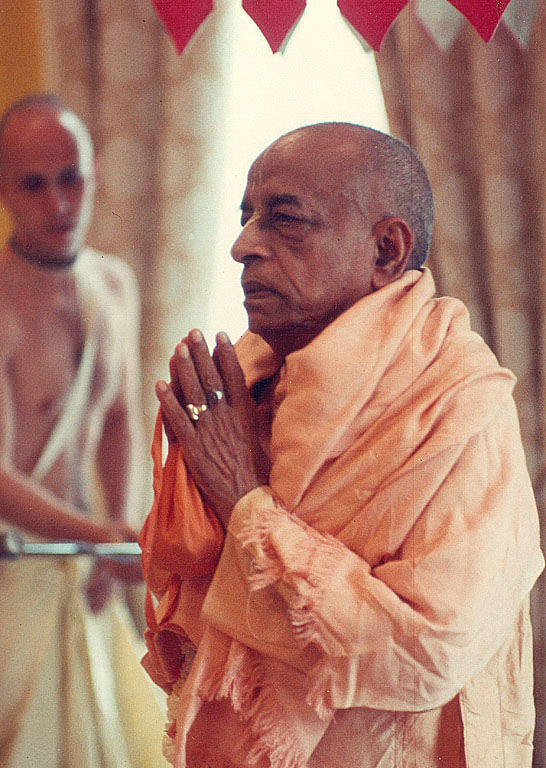
| Poem by Srila Prabhupada on His First Arrival in the USA Posted: 21 Jan 2012 07:48 AM PST Poem by Srila Prabhupada on His First Arrival in the USA “Excerpted from ‘Back To Godhead’ magazine, courtesy of The Bhaktivedanta Book Trust International, Inc., www.Krishna.com.” 1970, Vol. 1, No. 34 The spiritual master and founder of the International Society for Krishna Consciousness, His Divine Grace A.C. Bhaktivedanta Swami Prabhupada, is now engaging thousands of men and women in America and throughout the world in the science of bhakti-yoga, transcendental loving service to God. Prabhupada had no personal motive in first beginning ISKCON; he so vigorously preaches the philosophy of God consciousness simply because he has been ordered to do so by his own spiritual master, Srila Bhaktisiddhanta Sarasvati Gosvami Maharaja. His Divine Grace A.C. Bhaktivedanta Swami Prabhupada first arrived in the United States in 1965 with seven dollars, a letter of introduction to an Indian family in Pennsylvania, and a suitcase with some volumes of Srimad-Bhagavatam. In the following poem, written in Bengali on the day of his arrival in the USA, Srila Prabhupada addresses the Supreme Lord Krsna, asking Him His purpose in sending His servant to America. The translation from Bengali was done by Srila Prabhupada himself. As Follows; 1) My dear Lord Krsna, You are so kind upon this useless soul, but I do not know why You have brought me here. Now You can do whatever You like with me. 2) But I can guess that You have some business here, otherwise why should You call me to this demoniac place? 3) Most of the population here is covered by nature’s modes of ignorance and passion, and I do not know how they will be able to understand the transcendental message of Vasudeva. 4) But I know that Your causeless mercy can make everything possible because You are the most expert mystic. 5) Therefore, I am simply praying for Your mercy so that I can be able to convince them about Your message. 6) All living entities have come under the control of the illusory energy by Your will, and therefore, if You like, by Your will they can also be released from the clutches of illusion. 7) If You so desire, I wish that You may deliver them ; just by Your desire they will be able to understand Your message. 8) The words of Srimad-Bhagavatam are Your incarnation, and if they receive them in submissive aural reception, repeatedly, then they will be able to understand Your message. 9-13) In the Srimad-Bhagavatam, First Canto, Second Chapter, verses seventeen through twenty-one, it is said: “For anyone who gives aural reception to the always auspicious transcendental messages about You by hearing and chanting, You become a special well-wisher, and thus, remaining within his heart, You clear up all inauspicious understanding. When such inauspicious understanding is almost cleared up, a person realizes the importance of devotional service. In that stage of understanding, the influence of the modes of ignorance and passion becomes almost nil, and the resultant action of passion and ignorance can no more attack the heart; thus he becomes joyful, being situated on the platform of goodness. When, by dint of devotional service, he thus becomes jubilant due to awakening the modes of goodness, he becomes liberated from material contamination and is able to understand the science of God. In this stage of liberation, all misgivings in the heart, or the bondage of the material network, become cut to pieces, and by the science of God he is elevated from all sorts of doubts. At this stage the result of past activities becomes vanquished because of his realization of the Supreme Lord.” 14) This is the process of becoming liberated from the influence of the modes of ignorance and passion, and thus they can become freed from all inauspicious things accumulated in the heart. 15) But because I am very unfortunate, unqualified, and the most fallen, I am therefore seeking Your benediction so that I may be able to convince them about this Krsna consciousness. 16) Somehow or other, You have brought me here to speak about You. Now it is up to You to make me a success or failure, as You like. 17) You are the Lord of the whole creation, so if You like You can make my power to speak suitable, so that they can understand. 18) By Your causeless mercy only my words may become transcendentally pure, and I am sure that when such a transcendental message penetrates their hearts, certainly they will feel engladdened and thus become liberated from all unhappy conditions of life. 19) I am just like a puppet in Your hands; You have brought me here, and now You can make me dance as You like. 20) I have no devotion, nor have I any knowledge, but still I have been designated Bhaktivedanta. Now if You like You can just fulfill the real purport of Bhaktivedanta. The most unfortunate, insignificant beggar, Bhaktivedanta Swami, onboard the ship Jaladuta, Commonwealth Pier, Boston, Massachusetts (U.S.A.). Dated 18th September, 1965.         |


| You are subscribed to email updates from The Hare Krishna Movement To stop receiving these emails, you may unsubscribe now. | Email delivery powered by Google |
| Google Inc., 20 West Kinzie, Chicago IL USA 60610 | |



![Sri Sri Radha Vrindavana Chandra Darshan [Sri Krishna and Srimati Radha Rani] as on 14/May/2014](https://blogger.googleusercontent.com/img/b/R29vZ2xl/AVvXsEg5ij3dl6lO3Jkwg8fe7Tfzws_JTACPLEe7vQGY1hzQAIBYbloSV47iZBDlocsdT_P6yf-DkwJ2gmRR4z9NMmJl_zPan6gQ2Lirt2LX2KX7eKewfHBBNaKFyHlbEbY9UyHqcpmcPNdjq5s/s72-c/RVC2.jpg)
0 comments:
Post a Comment
Comments, Feedback, Trackbacks, Ping Backs will be much appreciated.
It will not only help The Hare Krishna Blog, but also help The Hare Krishna Movement, ISKCON devotees and people.
Help The Hare Krishna Blog to Grow!!! Spread the message and help it reach every corner of the world.
Your help will be greatly appreciated!!!