Chant Hare Krishna Blog - ISKCON - Hare Krishna Movement - Live Da

Chant Hare Krishna Blog - ISKCON - Hare Krishna Movement - Live Da

Navaratri – Celebrating the victory of good over evil

Navaratri – Celebrating the victory of good over evil

Inline image 1

Navaratri is a festival dedicated to the worship of Goddess Shakti. The word Navaratri literally means nine nights in Sanskrit, nava meaning nine and ratri meaning nights.  During these nine nights and ten days, nine forms of Shakti/Devi are worshiped. The 10th day is commonly referred to as Vijayadashami or Dussehra. The festival culminates with Dussehra, the victory of good over evil. The beginning of spring and the beginning of autumn are two very important junctions of climatic and solar influence. These two periods are taken as sacred opportunities for the worship of the Divine Mother. The dates of the festival are determined according to the lunar calendar.

Usually in late September/early October each year. This year, Navaratri starts on October 5 and ends on October 13.

The festival is celebrated all over India but in different ways. The traditional dances of Gujarat, known as garba and dandiya raas, are performed in circles with dancers dressed up in colorful clothes. Small, decorated sticks called dandiyas are used in the dandiya raas.

In Delhi, the feature of Navaratri celebrations are the Ramlila plays that take place all over the city. Towering effigies of the demon Ravana are burnt as part of these performances on Dussehra.


Over the course of the nine days, the Mother Goddess is worshiped in her various forms -- Durga, Lakshmi, and Sarasvati.

Each goddess is worshiped for three days in turn, starting with Durga who destroys negative tendencies. Next is Lakshmi who bestows good virtues and fortune, and last is Sarasvati, who instills wisdom and spiritual knowledge. The worship, accompanied by fasting, takes place in the mornings. Evenings are for feasting and dancing.

The Dusshera celebration of Mysore in Karnataka is a veritable extravaganza! Chamundi, a form of Durga, is the family deity of the Maharaja of Mysore. It’s a wonderful scene to watch the grand procession of elephants, horses and courtiers.

Hare Krishna and the Russian Orthodox Church

Hare Krishna Movement in Russia

A Ramanavami pooja conducted by  Hare Krishna followers in Russia. 
R&I Report: Mumbai's Marine Drive is hardly a place where you would expect to "bump into" a Russian Orthodox Church priest, let alone one from as far away as Siberia. On a breezy late-monsoon evening, a tall and young Russian man asked me the time. His features and accent had "Russian" written all over them and when my response came in his native language, he was pleasantly surprised. At first glance, I assumed the bearded man got lost somewhere in Goa's hippie trail and ended up in India's financial capital, but it was my turn to get surprised when I found out who he was.
The young priest hailed from Tomsk, a university town that unfortunately came in the radar of the Indian public in late-2011 when there were attempts by local officials to get the ISCKON version of the Bhagawad Geeta banned. He was in Mumbai to try and do some "personal research" on ISKCON or the Hare Krishna movement. After 3 months, he was convinced that the movement was not "extremist in nature" but still had reservations about its practitioners.
His knowledge of Hinduism as a whole was strong enough to put many practicing Hindus to shame. "Hinduism is a religion of freedom and encourages thought," he said. "But the ISKCON people both back home in Russia and here are neither open to debate or questioning." When I told him that I thought he was generalizing, he said that his talks with believers convinced him that they were on a mission of proselytism and were authoritarian. "This is a movement that refuses to recognize any other version of the Geeta except their own," he said. I couldn't challenge the statement that particular evening, but I did find out later on that there was truth in it.
"One can only be born a Hindu," the priest said. "So why are they trying to convert so many Orthodox Christians?"  He went on to say that Hindus are actually a race and that all Indians belong to that race, "which within its own principles allow people to practice or believe in whatever they wanted."  He said Sufi Islam in India was Hinduism as well. If he wanted to leave the Orthodox Church in Russia, there are enough organizations in India that would make him their poster boy.
His views are in no way meant to be taken as the word of the Russian Orthodox Church, but the young priest said the church was a unifying factor in Russia and was ideal for a country, that is largely homogenous, despite having many ethnic minorities. "India's greatness lies in it finding its Hindu spiritual roots and for all Indians to understand that and you see, Russia is again becoming great now since more people understand and appreciate traditional Russian Orthodox values," he said. 
The priest equated the Hare Krishna movement with Western missionaries and said both groups were looking at misleading Indians and Russians and destabilizing the countries. I'll admit that I have heard these "CIA agents" conspiracy theories but I am not really one hundred percent convinced.
The very fact that the young man came to India with an open mind to try and find out for himself what he heard from others has to go to his credit. He said he hoped that more people embraced vegetarianism and that in his opinion when Jesus said, "Thou shall not kill," he meant to include animals as well. When I joked that his "friends" from ISKCON were also vegetarians, he took it in good stride and laughed as he called them "extremists" in their vegetarianism as they refused to eat onions and garlic!
He kept insisting that the Orthodox Church has a lot of regard for Indian culture, customs and traditions, but then was critical of the Indian government for decriminalizing homosexuality.  Calling it a sin and a sickness, the young priest said homosexuality was a Western creation and a serious danger for India as well! Divorce, single-parents, alcoholic women and rejection of traditional values would spell doom for Russia and India. This he argued was an orchestrated plan by the West to keep the countries "in suffering."
Despite his speaking with clarity, I sensed a great degree of confusion in the young priest. He believed with his whole heart in the concept of a great Russia and a great India. Is some sort of religious conformity across both countries the only way to unite the largely "traditional" people and help the countries progress? The "godless Chinese" whose country is sandwiched between Russia and India seem to be doing just fine after experimenting first with the "Western evil" of communism and then with another "vice" from the West called capitalism.
Tailpiece: I personally love visiting Orthodox Churches and monasteries in Russia. Many of them are architectural marvels and the followers welcome outsiders, much in keeping with Russian tradition of hospitality.  This kind of openness towards outsiders is not seen in Hindu temples in some parts of India.

Darshan of Sri Sri Radha Vrindavana Chandra as on 26-Sep-2013

Sri Sri Radha Vrindavana Chandra Drashan [Lord Sri Krishna and Srimati RadhaRani] as on 26-Sep-2013 at "The Hare Krishna Movement", Sri Sri Radha Vrindavana Chandra Mandir, The Akshaya Patra Campus, Chattikara, Vrindavana, Mathura District, Uttar Pradesh".


Glimpse:


Darshan of Sri Sri Radha Vrindavana Chandra as on 22-Sep-2013

Sri Sri Radha Vrindavana Chandra [Lord Sri Krishna and Srimati RadhaRani] darshan as on 22-Sep-2013 at "The Hare Krishna Movement, Sri Sri Vrindavana Chandra Mandir, The Akshaya Patra Campus, Chattikara, Vrindavana, Mathura District, Uttar Pradesh, India".

Glimpse:


ISKCON Bangalore Lectures: Sri Stoka Krishna Dasa as on 19-Sep-2013

Lecture by His Grace Sri Stoka Krishna Dasa as on September 19 2013 at ISKCON Bangalore, Sri Sri Radha Krishna Chandra Mandir (Temple), Hare Krishna Hill, Cord Road, Beside to Narayana Netralaya, Rajajinagar, Bangalore 560010, Karnataka, India.


Download Lecture:
Date: 19
Day: Thursday
Month: September (09)
Year: 2013
Place: ISKCON Bangalore
Speaker: His Grace Sri Stoka Krishna Dasa

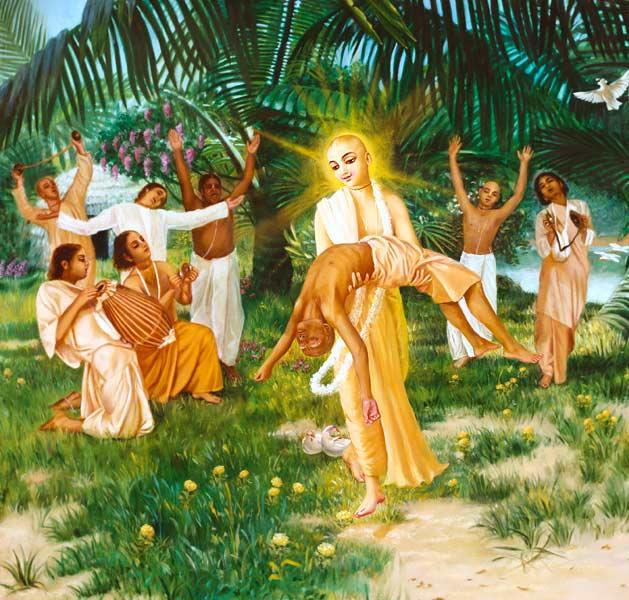
Disappearance of Haridasa Thakura

Disappearance of Haridasa Thakura 


HaridasaThakura1 

After the passing away of Haridāsa Ṭhākura, the Lord Himself took his body on His lap, and He danced with it in great ecstasy. (Sri Caitanya-caritamrta Adi-lila 10.46)
Today being the Disappearance of Haridāsa Ṭhākura, we honor him with this short post. We have selected a verse from the Bhagavad-gita 6.44 wherein Srila Prabhupada mentions in the purport;

…Lord Caitanya, accepted Ṭhākur Haridāsa as one of His most important disciples. …he was elevated to the post of nāmācārya by Lord Caitanya due to his rigidly attended principle of chanting three hundred thousand holy names of the Lord daily: Hare Kṛṣṇa, Hare Kṛṣṇa, Kṛṣṇa Kṛṣṇa, Hare Hare/ Hare Rāma, Hare Rāma, Rāma Rāma, Hare Hare.

Full Text and Purport

Bhagavad-gita As It Is 1972 Edition
By His Divine Grace A.C. Bhaktivedanta Swami Prabhupada
Chapter Six, Text 44

pūrvābhyāsena tenaiva
hriyate hy avaśo ‘pi saḥ
jijñāsur api yogasya
śabda-brahmātivartate


pūrva—previous; abhyāsena—practice; tena—by the influence of that; eva—certainly; hriyate—is attracted; hi—surely; avaśaḥ—helpless; api—also; saḥ—he; jijñāsuḥ—willing to know; api—so; yogasya—of yoga; śabda-brahma—ritualistic principles of scripture; ativartate—transcends.

TRANSLATION

By virtue of the divine consciousness of his previous life, he automatically becomes attracted to the yogic principles—even without seeking them. Such an inquisitive transcendentalist, striving for yoga, stands always above the ritualistic principles of the scriptures.

PURPORT

Advanced yogīs are not very much attracted to the rituals of the scriptures, but they automatically become attracted to the yoga principles, which can elevate them to complete Kṛṣṇa consciousness, the highest yoga perfection. In the Śrīmad-Bhāgavatam (3.33.8), such disregard of Vedic rituals by the advanced transcendentalists is explained as follows:

aho bata śvapaco ‘to garīyān
yajjihvāgre vartate nāma tubhyam
tepus tapas te juhuvuḥ sasnur āryā
brahmānūcur nāma gṛṇanti ye te.

“O my Lord! Persons who chant the holy names of Your Lordship are far, far advanced in spiritual life, even if born in families of dog-eaters. Such chanters have undoubtedly performed all kinds of austerities and sacrifices, bathed in all sacred places, and finished all scriptural studies.”

The famous example of this was presented by Lord Caitanya, who accepted Ṭhākur Haridāsa as one of His most important disciples. Although Ṭhākur Haridāsa happened to take his birth in a Moslem family, he was elevated to the post of nāmācārya by Lord Caitanya due to his rigidly attended principle of chanting three hundred thousand holy names of the Lord daily: Hare Kṛṣṇa, Hare Kṛṣṇa, Kṛṣṇa Kṛṣṇa, Hare Hare/ Hare Rāma, Hare Rāma, Rāma Rāma, Hare Hare. And because he chanted the holy name of the Lord constantly, it is understood that in his previous life he must have passed through all the ritualistic methods of the Vedas, known as śabda-brahman. Unless, therefore, one is purified, one cannot take to the principle of Kṛṣṇa consciousness nor become engaged in chanting the holy name of the Lord, Hare Kṛṣṇa.

Darshan of Sri Sri Radha Vrindavana Chandra as on 10-Aug-2013

Darshan of Sri Sri Radha Vrindavana Chandra [Sri Krishna and Srimati Radha Rani] as on 10-Aug-2013 at ISKCON Sri Sri Radha Vrindavana Chandra Mandir, The Akshaya Patra Campus, Chattikara, Vrindavan, Mathura District, Uttar Pradesh, India.


Glimpse:


SERP Visits Today

5f3996de42a54ebbcbf932a02fe8d8c5a889d057


Copyright @ 2014 Chant Hare Krishna Blog.